
A musty, earthy smell in one room, closet or cabinet that comes back after cleaning.
Home · Mold Remediation
Mold Remediation in Boca Raton, FL
Mold after water damage is common here. Warm rooms, humid air and a leak that went unnoticed for a few days are all it takes. Aqua Revive’s mold remediation in Boca Raton is carried out by a Florida-licensed mold remediator. We seal off the affected area, remove what can’t be cleaned, and clean the rest to the IICRC S520 standard. Then an independent assessor confirms the work passed before your walls are closed up.
Call (561) 979-0130 · Florida-licensed mold remediator MRSR-2847 · IICRC WRT & ASD Cert. No. 84712 · Open Monday – Saturday 8:00 AM – 6:00 PM
Signs the Water Damage Has Turned Into Mold
Dark spots or fuzzy patches on drywall, baseboards, the back of cabinets or around AC vents.
Staining or soft drywall near a past leak, a window or an AC closet.
Allergy-type symptoms that ease when you leave the house (talk to your doctor about any health concerns).
A leak that ran for more than a day or two before it was dried properly.
In our humidity, mold can start growing on wet drywall and wood within 24 to 48 hours. If the wet area was never dried with professional equipment, assume there may be growth inside the wall even if the surface looks clean.
Can I clean a small patch of mold myself?
Often, yes. The EPA’s guidance is that most homeowners can handle an area smaller than about 10 square feet, with gloves, an N-95 mask and goggles, as long as the moisture problem is fixed. Florida’s mold licensing law also starts at 10 square feet. Above that, or if it’s inside walls, in the AC system, or followed sewage or floodwater, call a licensed professional.
How Florida Regulates Mold Work, and Why It Protects You
Florida is one of the few states that licenses mold work. Under Chapter 468, Part XVI of the Florida Statutes, the DBPR licenses individuals, not companies, as mold assessors (who test and write the plan) and mold remediators (who do the removal). For jobs over 10 square feet, the people doing the work must hold the right license. You can check any license on the DBPR license search.
Florida law also keeps testing and removal separate. A mold assessor may not remediate a property they assessed within the previous 12 months. That’s deliberate: the person who decides how big the problem is shouldn’t profit from the removal. We work with independent licensed assessors and welcome their clearance testing.
How Our Mold Remediation Works
The IICRC S520 standard sets the method. The goal isn’t to “kill” mold with a spray. It’s to physically remove contaminated material and return the area to normal background levels.
-
Assessment and plan
An independent licensed assessor, or your own if you’ve hired one, inspects the area, takes samples if needed and writes a remediation protocol: what gets removed, how far, and what clearance looks like.
-
Fix the moisture first
Mold comes back if the water source isn’t solved. If the cause is a hidden leak, our leak detection team traces it before removal starts.
-
Containment
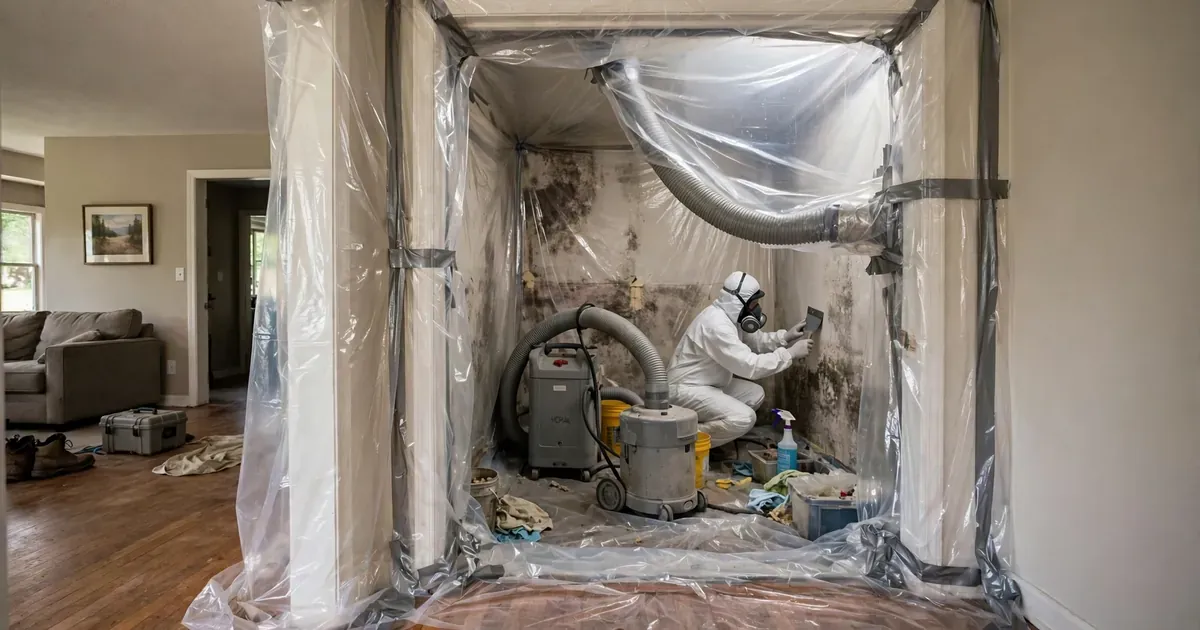
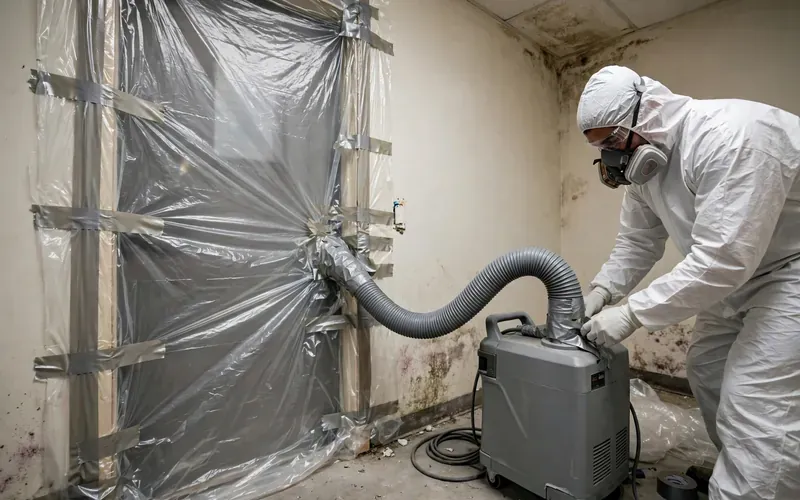
Plastic sheeting and zip walls seal the work area. A HEPA air scrubber keeps it under negative pressure, so spores are pulled into the filter instead of spreading through your home or the condo hallway.
-
Protective equipment
Technicians wear respirators, suits and gloves, matched to the size of the job.
-
Removal
Porous materials with growth, such as drywall, insulation and carpet pad, are cut out, bagged inside containment and carried out sealed. Framing and other materials that can be cleaned are HEPA-vacuumed and cleaned.
-
Detail cleaning and drying
All surfaces in containment are HEPA-vacuumed and wiped. Any remaining moisture is dried to the dry standard with structural drying equipment.
-
Clearance
The independent assessor inspects and tests the area. Containment comes down and rebuilding starts only after it passes.
Do you need to test for mold before remediation?
Not always. If the growth is visible and the cause is clear, the assessor may not need lab samples to write the plan. Testing matters when you smell mold but can’t see it, after sewage or floodwater, and almost always for clearance at the end.
Will bleach or a fogger fix it?
No. Bleach can lighten surface staining on non-porous surfaces, but it doesn’t remove growth from porous materials like drywall, and it adds water. Foggers and sprays alone don’t remove contaminated material. The S520 approach is removal and cleaning, plus fixing the moisture.
Mold in Boca Raton Homes and Condos
AC closets and air handlers
A slow condensate leak in a hall closet is one of the most common sources of hidden mold we see. If growth is inside the air handler or ducts, a licensed HVAC contractor cleans or replaces those parts.
Seasonal homes
A home closed up for the summer with the AC off, or a leak nobody found for weeks, is the classic setup for whole-room mold.
Condo walls between units
Growth in a shared wall may involve your unit, your neighbor’s and the association’s common elements. Containment and clearance have to work for all three, and so does the paperwork.
After storms
Floodwater and wind-driven rain soak drywall and insulation that often can’t be dried in time. Those losses frequently need remediation, not just drying.
What Mold Remediation Costs
Remediation is priced on the affected area, not the size of your home. A 2026 South Florida price guide puts it at about $10 to $25 per square foot of affected material. Most single-room jobs fall between $1,500 and $6,000, and post-remediation verification by the assessor typically adds $300 to $500 (AdvantaClean Fort Lauderdale). Hard access, such as attics, inside cabinets or high-rise logistics, adds time. You get a written estimate based on the assessor’s protocol.
Insurance and Mold
Covered loss vs neglect. Many Florida policies cover mold that results from a sudden, covered water loss, but exclude mold from long-term leaks, humidity or lack of maintenance.
Mold limits. Many policies cap mold coverage at a figure far below the dwelling limit. Check your policy for a mold endorsement or sublimit.
Documentation counts. The assessor’s report, our photos, the removal scope and the clearance results show the work was necessary and done properly.
General information, not insurance or legal advice.
Related Services
- Emergency Water Extraction — Standing water pumped out fast, day or night
- Structural Drying & Dehumidification — Drying to a measured dry standard, with daily moisture readings
- Leak Detection — Tracing hidden leaks behind walls, under tile and in slabs
- Sewage Backup Cleanup — Safe removal and disinfection of Category 3 water
- Flood & Storm Damage — Cleanup and drying after storm, street flood or king-tide water
- Water Damage Repair & Reconstruction — Rebuilding what couldn’t be saved, matched to what was there
- Commercial Water Damage — Water damage restoration for Boca Raton businesses
Where We Provide Mold Remediation in Boca Raton
We provide mold remediation across East Boca & Downtown (33432, 33431), Northeast Boca (33487), Central Boca (33486, 33433) and West Boca (33434, 33428, 33496, 33498). We also cover Highland Beach, Delray Beach, Deerfield Beach, Boynton Beach, Coconut Creek, Parkland and Lighthouse Point.
East Boca & Highland Beach · Northeast Boca + Delray & Boynton · Central Boca + Deerfield & Lighthouse Point · West Boca + Coconut Creek & Parkland
Mold Remediation FAQs
How do I know if the mold is serious?
Size, location and cause decide it. More than about 10 square feet, growth inside walls, ceilings or the AC system, or mold after sewage or floodwater all need a licensed professional. A persistent musty smell with nothing visible is also worth an assessment.
Can I stay home during mold remediation?
Usually, yes, for a contained job in one room. Containment and negative air keep the work area sealed off from the rest of the home. For large jobs, or if anyone in the household has asthma, a weakened immune system or a respiratory condition, staying elsewhere may be wiser; ask your doctor.
How long does mold remediation take?
A single-room job often takes a few days, from containment to clearance. Larger areas, removal across several rooms, or waiting for lab results add time. Rebuilding starts after clearance passes.
Why can’t the company that tested my home also remove the mold?
Florida law says a mold assessor may not remediate a property they assessed within the last 12 months. The rule prevents the person who sizes up the problem from profiting on the removal. It’s a protection for you, not a hassle.
Will the mold come back?
Not if the moisture source is fixed and the area is dried and cleaned to standard. Mold returns when a leak continues, the AC drain clogs again, or a home sits humid with the AC off. We’ll tell you exactly what caused it and how to keep it from happening again.
Does homeowners insurance cover mold remediation in Florida?
Sometimes. Mold that results from a sudden, covered leak is often covered up to a mold limit, which can be low. Mold from long-term leaks, humidity or poor maintenance is usually excluded. Your declarations page and mold endorsement spell out your coverage.
Smell Mold or See It Growing? Call Aqua Revive
Don’t scrub it or spray it. Close the door, keep the room’s AC running, and call (561) 979-0130. We’ll find the moisture behind it and remove it the way Florida law and the IICRC standard require.